Genolife

Liquid Biopsy and Its Advantages

The extensive progress in clinical research and the advances that have been made since the human genome was first sequenced have greatly expanded our understanding of cancer genetics and contributed to the development of new molecular biology tools.

One such tool is the liquid biopsy, a technique used primarily to detect tumor cells and tumor-derived products in peripheral blood, which has the advantage of being minimally invasive, sensitive, and cost-effective.

Some of the biomarkers released by tumors—either into the peripheral blood or other bodily fluids—are circulating tumor cells (CTCs), circulating tumor DNA (ctDNA), extracellular vesicles (EV) (exosomes and microvesicles) (Wang et al., 2017).

Circulating tumor cells

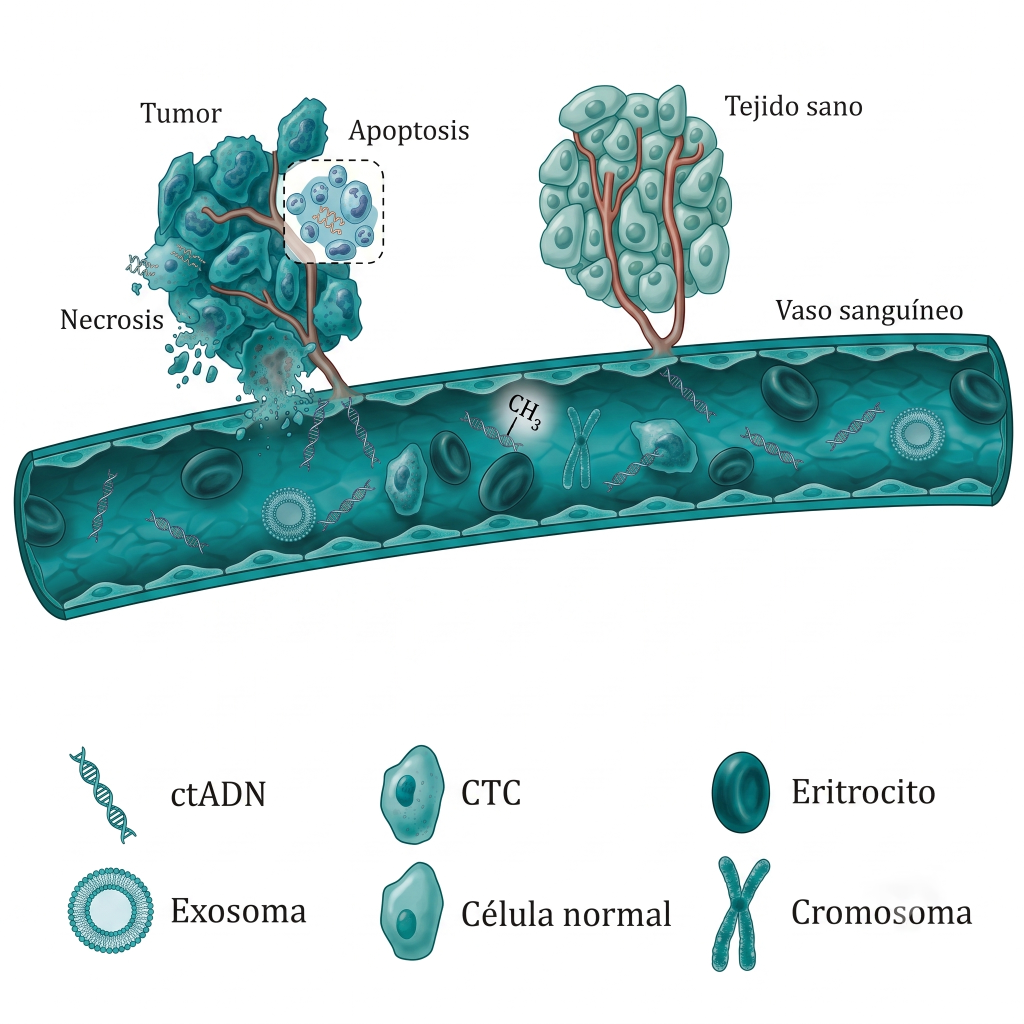
The circulating tumor cells They enter the bloodstream by passing through the wall of a blood vessel and then detach from the tumor, travel to other parts of the body, and form metastases (Lianidou and Pantel, 2019) (Fig. 1). The quantification of circulating tumor cell biomarkers and circulating proteins, including prostate-specific antigen, is used to diagnose cancer in clinical practice.

However, the plasma protein biomarkers currently in use, such as alpha-fetoprotein and carcinoembryonic antigen, have low sensitivity and low positive predictive value, which leads to false-negative results in patients with a low tumor burden (von Bubnoff, 2017).

ctDNA

The ctDNA it can be free of primary tumors, CTCs or detectable metastases in the blood of cancer patients. This type of DNA originates from apoptotic and necrotic tumor cells that release their DNA fragments into the blood (Fig. 1). Its concentration in serum and blood is significantly higher than in healthy individuals, and this is correlated with the severity of the disease (Kustanovich et al., 2019)

ctDNA has been used as a biomarker in an increasing number of cancer types, including lymphoma, melanoma, GIST, thyroid cancer, breast cancer, colon cancer, and lung cancer screening, to detect common mutations, such as BRAF, EGFR, KRAS, PIK3CA, TP53, KIT, PDGFRA, and ESR1 (Gonzales-Cao et al., 2015).

For this reason, the analysis of ctDNA It is useful for ongoing monitoring of tumor alterations due to the high turnover rate of circulating DNA and its ability to rapidly assess alterations in tumor genomics and identify epigenetic changes (Rossi and Ignatiadis, 2019).


Extracellular vesicles (exosomes and microvesicles)

Exosomes are extracellular vesicles enclosed in a lipid bilayer that carry RNA, DNA, and proteins secreted by cells and subsequently circulating in the blood (Poulet et al., 2019) (Fig. 1).  Both tumor DNA (ctDNA) as well as free-circulating DNA (cfADN) are found in exosomes, providing genomic information about cellular mutations in the tumor, and are used for diagnostic, prognostic, and therapeutic purposes (Jia et al., 2017).

Advantages Over Tissue Biopsy
  • Easy-to-obtain sample

  • Minimally invasive procedure

  • Results in a short time

  • Sensitive and precise

  • Early Detection of Cancer

  • Identification of Multiple Tumor Sites

  • Personalized Treatment and Monitoring

  • Relapse Diagnosis

Are you interested in any of our services?

Schedule an appointment with our specialists.