


What is Fragile X syndrome?
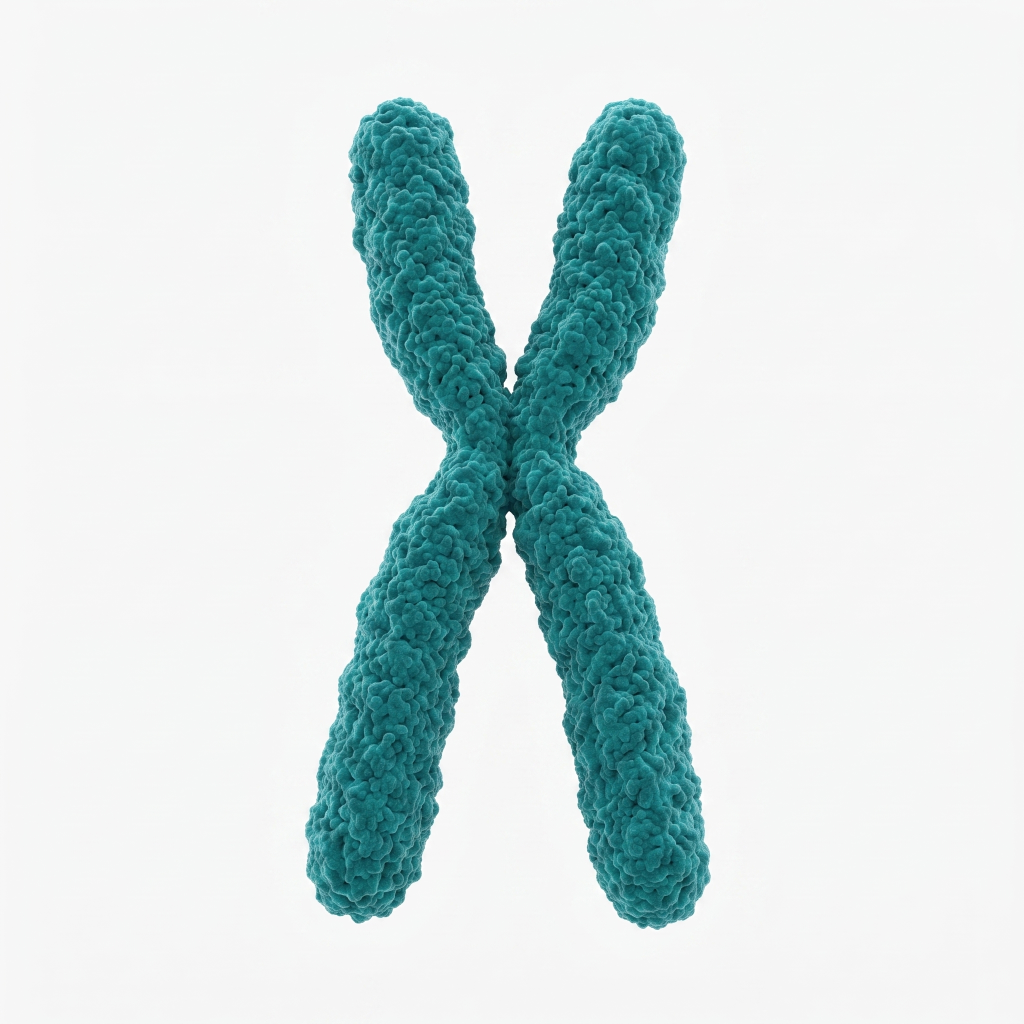
Fragile X syndrome (FXS) is the most common hereditary cause of intellectual disability, affecting approximately 1 in every 4,000 men.
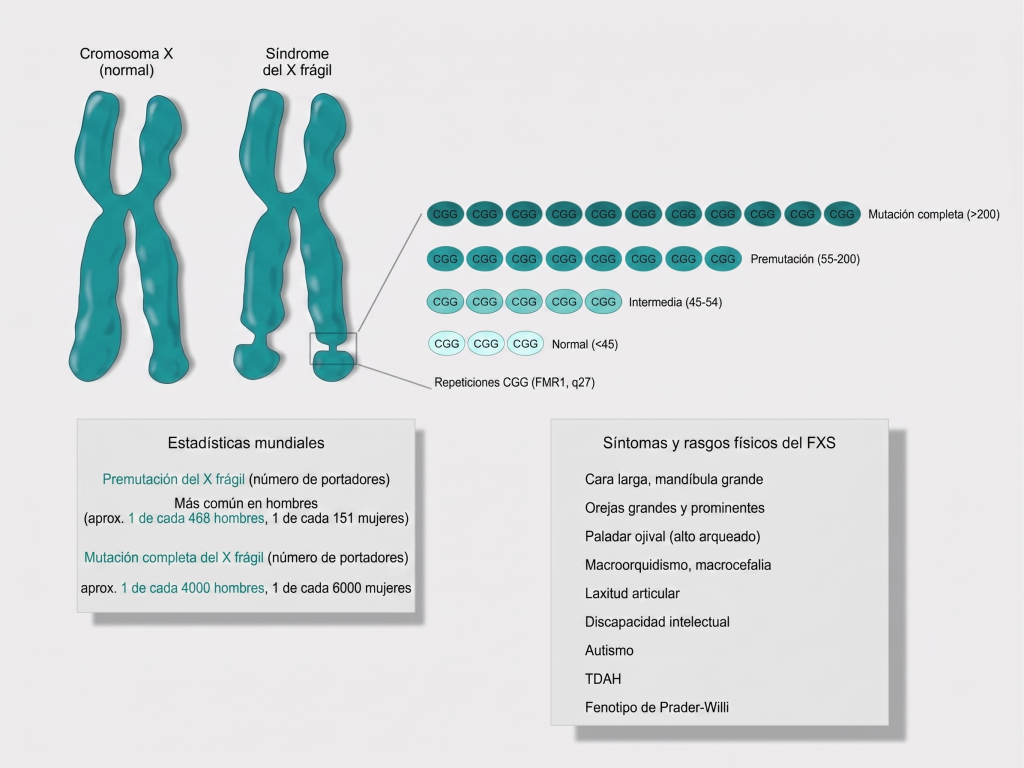
In the vast majority of cases, this X-linked disorder is caused by CGG repeats in the 5′ untranslated region (UTR) of the FMR1 gene.
The alleles responsible for FXS, or complete mutations, contain 200 or more copies of the repeat that are hypermethylated and transcriptionally silenced.
Unstable alleles that result in full-loss-of-function mutations are called premutations and are associated with phenotypes other than FXS.
The mutational mechanism, combined with the location of this gene on the X chromosome, leads to distinctive inheritance patterns in which the relevant alleles are passed from intellectually normal men to their unaffected daughters and then to their affected sons.
FXS may be suspected in both sexes and involves a variable clinical phenotype. Individuals with FXS may present with a range of symptoms, from learning difficulties and a normal IQ to severe intellectual disability and autistic behaviors. Physical characteristics have been described, but they are often nonspecific. Thus, diagnosis is based on the detection of mutations in the FMR1 gene.
The physical characteristics of FXS are quite subtle, and the first clinical sign is usually developmental delay, mild motor delays, and/or language delays.
Autistic-like behaviors, such as hand flapping, poor eye contact, and hand biting, may be observed.
The average IQ among adult men with the fully methylated mutation is approximately. Men who are less severely affected typically have incomplete methylation, which results in incomplete activation of FMR1, and they may even have an IQ at the lower end of the normal range or in the low-normal range.
In general, for FXS, cognitive deficits include problems with working memory and short-term memory, executive function, and mathematical and visuospatial skills.
Because the disorder is X-linked, women are generally affected much less severely than men, particularly in terms of cognitive functioning, but they tend to have a higher risk of emotional problems compared to the general population.
Women with the full mutation typically have a normal or borderline IQ, and most will have learning disabilities and/or associated emotional problems.
People with FXS generally do not have significant medical problems.
Recurrent otitis media and recurrent sinusitis are common during childhood.
There may be joint laxity with hyperextensibility in the finger joints and flat feet, which generally improve with age. Gastroesophageal reflux disease occurs in one-third of young infants with FXS and may present as irritability or recurrent vomiting.
Seizures and epilepsy are another common feature of FXS during childhood, with an incidence ranging from 13 to 18 % in boys and 5 % in girls.
Most people with the premutation have normal intelligence, but men are prone to attention problems, executive dysfunction, social deficits, and obsessive-compulsive behavior. Approximately 20 % of women with an FMR1 premutation have premature ovarian failure (POF), which is the premature cessation of menstruation before age 40.
Childhood
- Reflux
- Emesis (vomiting)
- Hypotonia
- Poor suction
Crawling
- Mild motor delays
Walking
- Seizures
- Hyperactivity
- Language Delays
- Onset of Anxiety
- Sensory Overstimulation
- Recurrent Otitis
Puberty
- Impulsivity
- Assault
- Symptoms of Autism
- Poor eye contact
- Temper Tantrums
- Anxiety
Adolescence
- More aggression
- Anxiety
- Impulsivity
- Hyperactivity
- Poor service
Adultez
- More aggression
- Anxiety
- Impulsivity
- Hyperactivity
- Poor service
- Perseverance
Old Age
- Symptoms of Parkinson's Disease
- Cognitive impairment
The behavioral phenotype may be helpful in suggesting a diagnosis of FXS.
Autism-like traits are common in people with FXS and include hand flapping, hand biting, avoidance of eye contact, tactile defensiveness, and hypersensitivity to sensory stimuli.
These characteristics, along with impaired social skills—such as socioemotional reciprocity—are present to varying degrees in children with FXS and may be indicative of a concurrent diagnosis of autism spectrum disorder or autistic-like behavior.
Anxiety and mood disorders, hyperactivity, impulsivity, and aggressive behavior may also occur.
The emotional and behavioral characteristics of women with FXS tend to vary. Women with the full mutation are prone to social anxiety, shyness, social avoidance, withdrawal, language deficits, mood lability, and depression.
In addition, it has also been reported that women with the premutation experience social anxiety.
In 1991, the gene responsible for FXS, FMR1, was identified. Fragile X was the first known example of a trinucleotide repeat disorder.
There are four allelic classes for the CGG repeat sequence in the 5′-UTR of FMR1.
The repeat sizes for each group are not well defined, and this complicates genetic counseling. In the general population, the repeat tract contains up to 40 repeats, with 30 being the most common (normal or common alleles). Then there are the intermediate alleles, which range from 41 to 54 repeats and are generally not associated with repeat tract instability.
Full-length mutations, which cause FXS, have more than 200 copies of the repeat.
It is standard practice to order the Fragile X test for all children with developmental delay, intellectual disability, or autism, although this test may have a diagnostic yield of only approximately 1–2%.
A family history of movement disorders, learning disabilities, intellectual disability, or primary ovarian insufficiency in the proband should raise suspicion of the presence of FMR1 mutations in the family.
The testing procedure consists of two complementary tests.
PCR with primers flanking the repeat is used to determine the number of CGG repeats in the 5′-UTR, and genomic DNA Southern blotting is used to determine methylation status and measure the size of complete mutations, which are often resistant to PCR amplification. The combination of Southern blot and PCR for the detection of fragile X-associated mutations has a sensitivity of 99%.
If a positive FXS test result is detected, the patient and family should be referred for genetic counseling and testing of family members at risk of carrying a full mutation or a premutation.
Women who are carriers of a premutation should be counseled about the risks of passing on a full mutation to their children.
When planning testing for an affected family, special attention should be given to family members with intellectual disability, learning disabilities, autism, or social and behavioral disorders; female relatives with infertility or premature menopause; and those with tremors, ataxia, or other neurological and psychiatric conditions.
Psychopharmacological treatment should be combined with other supportive strategies, including speech therapy, sensory integration occupational therapy, individualized education plans, and tailored behavioral interventions to maximize functioning.
In children with FXS, the most commonly used medications are stimulants. These medications target symptoms of hyperactivity, impulsivity, and inattention and can be very helpful in these areas. Although they are the most common medications used for FXS, their effectiveness and side effects vary from person to person. The response rate to stimulants may be relatively lower in adult males with FXS due to their higher levels of anxiety and lower activity levels.